
Environmental Services · UAE & GCC

Environmental Studies
& Assessments

Comprehensive EIAs, SEIAs, HSEIAs, baseline surveys, air dispersion modeling, and environmental audits — delivering authority-approved studies that protect your project timeline and ensure full UAE & GCC regulatory compliance.
200+EIAs Delivered
15+Regulatory Bodies
98%Approval Rate
9Study Types
20+Years Experience
Our studies are accepted by these UAE & GCC environmental authorities
EAD
Environment Agency – Abu Dhabi
TRAKHEES
Dubai Ports, Customs & FZ Corp
EPDA
Environmental Protection Dept – Abu Dhabi
ADDED
Abu Dhabi Dept of Economic Dev
MOCCAE
Ministry of Climate Change & Env
DM / DED
Dubai Municipality & Econ Dev
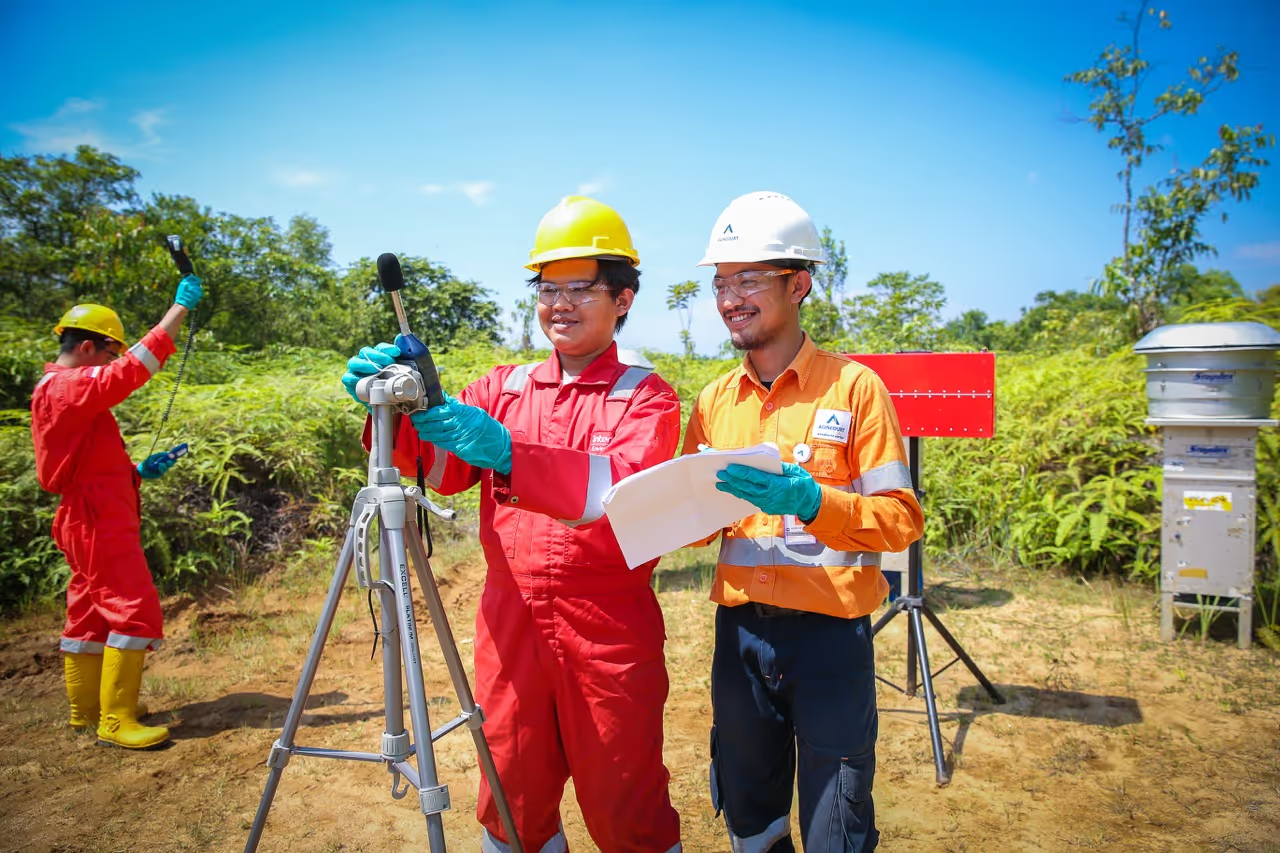
GCEEC environmental assessment fieldwork
ISO 14001Certified Process
// About This Service

Expert Assessments That Get Approved — First Time

At Green Crescent Environmental Engineering Consultants (GCEEC), we provide comprehensive Environmental Studies and Assessments that protect projects across the UAE & GCC from regulatory delays, permit rejections, and enforcement action.

Environmental assessments are not merely a compliance formality — they are the foundation on which every responsible development is built. Our studies provide clients and regulators with the rigorous, field-verified data and analysis needed to make confident, legally defensible decisions at every project stage.

We have deep, established relationships with EAD, TRAKHEES, EPDA, ADDED, MOCCAE, and Dubai Municipality — allowing our submissions to move faster through review pipelines and our clients to meet project milestones without avoidable delays.

From pre-feasibility screening and scoping through to post-construction environmental audits, GCEEC provides a seamless end-to-end service with a single point of accountability.

EIA / SEIA / HSEIA CEMP / OEMP Baseline Surveys Air Dispersion Modeling Environmental Audits Ecological Assessment Risk Assessment Geology Studies
// Study Types

Nine Specialist Environmental Study Services

Every study type we deliver is tailored to your project stage, sector, and the specific authority requirements of your emirate or GCC country.

Our team has delivered every one of these study types across construction, industrial, infrastructure, oil & gas, and real estate projects — with documented approval from the relevant regulatory authority in each case.

Not sure which study type your project requires? Contact our team for a free scoping discussion — we'll identify exactly what you need and when.

Study 01
Environmental Impact Assessment (EIA)
Full-scope EIAs evaluating the potential environmental and social impacts of new developments before construction begins. Our EIAs follow the UAE Federal Law No. 24/1999 requirements and the specific procedural guidelines of the relevant emirate authority — from scoping meetings through to final submission and approval.
Includes
  • Project description & alternatives analysis
  • Environmental baseline data compilation
  • Impact identification, prediction & evaluation
  • Mitigation measures & residual impact assessment
  • Environmental Management Plan (EMP)
  • Stakeholder consultation & public disclosure
EAD CompliantTRAKHEESMOCCAEAll Sectors
Study 02
Strategic Environmental Impact Assessment (SEIA)
High-level assessments applied to policies, plans, and programs before site-specific decisions are made. SEIAs provide strategic environmental safeguards for master plans, zoning policies, and sectoral development strategies — establishing the environmental framework within which subsequent project-level EIAs are conducted.
Includes
  • Policy & plan description and context
  • Strategic baseline environment assessment
  • Cumulative and synergistic impact analysis
  • Alternatives and strategic options evaluation
  • Monitoring & adaptive management framework
Master PlanningPolicy LevelGCC Wide
Study 03
Health, Safety & Environmental Impact Assessment (HSEIA)
Combined assessments integrating occupational health risks, safety hazard analysis, and environmental impact evaluation into a single, unified document. HSEIAs are mandatory for industrial facilities, petrochemical plants, and energy projects in Abu Dhabi and are increasingly required across the wider UAE industrial sector.
Includes
  • Hazard identification & risk assessment (HAZID/HAZOP)
  • Health impact assessment at community receptors
  • Environmental impact assessment of operations
  • Emergency response & spill risk analysis
  • Combined HSEIA report to ADNOC / EAD format
IndustrialOil & GasEnergyADNOC
Study 04
Construction Environmental Management Plan (CEMP)
Site-specific management plans required by UAE authorities as a condition of construction permit approval. CEMPs specify the environmental controls, monitoring protocols, and responsibilities that apply throughout the construction phase — addressing dust, noise, waste, water, and community impacts with measurable targets and compliance thresholds.
Includes
  • Dust & air quality management protocols
  • Noise & vibration control measures
  • Construction waste management plan
  • Water & drainage management controls
  • Environmental monitoring schedule & KPIs
  • Roles, responsibilities & incident reporting
Construction PhasePermit RequiredAll Emirates
Study 05
Operational Environmental Management Plan (OEMP)
Lifecycle environmental management frameworks for facilities entering operations. OEMPs define how environmental performance is maintained, monitored, and improved throughout a facility's operational life — covering emissions management, effluent control, waste handling, incident response, and periodic compliance auditing against permit conditions.
Includes
  • Operational environmental aspects & impacts register
  • Emissions, effluent & waste management protocols
  • Environmental monitoring program & reporting
  • Incident, spill & emergency response procedures
  • ISO 14001 integration & continual improvement
Operational PhaseISO 14001Industrial
Study 06
Baseline Environmental Surveys
Pre-project surveys that establish a comprehensive environmental baseline — the scientific benchmark against which all project impacts are later measured, assessed, and reported. Conducted before any site disturbance, our baseline surveys capture the true pre-project environmental condition across all relevant receptors and media.
Includes
  • Ambient air quality & meteorological baseline
  • Noise & vibration ambient levels survey
  • Surface water & groundwater quality assessment
  • Soil & sediment characterization
  • Flora, fauna & habitat mapping
  • Socio-economic & land-use baseline
Pre-ProjectMulti-ParameterField Verified
Study 07
Air Dispersion Modeling
Quantitative prediction of pollutant dispersion from stacks, roads, quarries, industrial plants, and other emission sources using validated regulatory models. Our air dispersion studies identify maximum ground-level concentrations at sensitive receptors, assess compliance with ambient air quality standards, and support permit applications requiring an air quality impact assessment.
Includes
  • Source emission inventory & characterization
  • Meteorological data analysis & wind rose
  • AERMOD / CALPUFF dispersion modeling runs
  • Receptor grid & sensitive receptor analysis
  • Cumulative impact assessment with background
  • Mitigation recommendations if exceedances found
AERMODCALPUFFIndustrial PermitsStack Testing
Study 08
Ecological & Biodiversity Assessment
Field surveys and desktop reviews identifying, mapping, and evaluating ecological receptors — protected species, sensitive habitats, migratory corridors, and marine ecosystems — within and around the project footprint. Our ecological assessments determine the significance of project impacts on biodiversity and prescribe proportionate, legally compliant mitigation or offset measures.
Includes
  • Desktop review of protected areas & species records
  • Phase 1 habitat survey & NVC vegetation survey
  • Protected species surveys (birds, reptiles, mammals)
  • Marine ecology & coral reef assessment
  • Biodiversity impact assessment & significance matrix
  • Biodiversity offset & compensation plan
Protected SpeciesMarine EcologyHabitat Mapping
Study 09
Environmental Audits & Compliance Reviews
Independent third-party environmental audits verifying whether operational facilities comply with their permit conditions, approved environmental management plans, and applicable UAE environmental legislation. Our audit findings include a gap analysis, corrective action plan with prioritized recommendations, and implementation support — protecting organizations from regulatory penalties, permit revocations, and reputational risk.
Includes
  • Document review: permits, plans & monitoring records
  • Site inspection & physical compliance verification
  • Gap analysis against permit conditions & legislation
  • Non-conformance register & risk rating
  • Corrective action plan (CAP) with owner & timeline
  • Follow-up verification audit (optional)
Third-Party AuditCompliance GAPPermit Conditions
// What You Receive

Study Deliverables & Typical Timeline

Every GCEEC environmental study produces structured, authority-formatted outputs — and we manage the entire delivery timeline so your project schedule is protected.

Authority-Formatted Study Report
Full technical report structured to the exact format required by the relevant UAE or GCC environmental authority — including executive summary, methodology, findings, impact assessment, and mitigation plan.
Baseline Data Appendices
All field survey results, laboratory analysis certificates, monitoring records, and GIS mapping outputs compiled in a fully referenced appendix package that supports the study findings and satisfies authority data requirements.
Authority Submission & Query Management
We manage the full submission process including portal uploads, liaison with authority reviewers, response to technical queries, and attendance at authority meetings — reducing the approval burden on your project team.
Approval Certificate & Permit Conditions
Following authority approval, we provide a clear summary of all permit conditions, EMP commitments, and monitoring obligations — ensuring your project team understands what is required to remain compliant throughout construction and operation.
Typical EIA Delivery Timeline
1
Week 1–2
Scoping & Methodology Approval
Project briefing, regulatory scoping, methodology agreed with authority where required, baseline data collection commences.
2
Week 2–6
Baseline Surveys & Field Data Collection
On-site environmental surveys, laboratory sampling, stakeholder engagement, and desktop data compilation — all QA/QC reviewed.
3
Week 6–10
Impact Assessment & Modeling
Quantitative and qualitative impact analysis, air dispersion or noise modeling where required, mitigation hierarchy applied.
4
Week 10–12
Draft Report & Client Review
Draft EIA issued for client review, comments incorporated, report finalized with full appendices and GIS mapping.
5
Week 12+
Submission, Review & Approval
Authority submission managed by GCEEC, queries answered, approval issued. Authority review periods vary (typically 4–12 weeks depending on complexity).
// Our Methodology

How We Deliver Every Study

A rigorous five-stage methodology — from regulatory scoping to authority approval — applied consistently to every environmental study we undertake.

1
Regulatory Scoping
Identify applicable legislation, confirm study type requirements, and establish the scope of assessment with the relevant authority where necessary.
2
Baseline Data Collection
Field surveys, laboratory testing, satellite analysis, and stakeholder consultation to build a comprehensive, site-specific environmental baseline dataset.
3
Impact Prediction & Modeling
Quantitative and qualitative impact assessment using validated models — AERMOD, CALPUFF, noise modeling — with mitigation hierarchy applied at every identified impact pathway.
4
Report Preparation
Authority-formatted technical report produced with full appendices, GIS mapping outputs, and a client review cycle before final submission.
5
Submission & Approval
Direct submission to authority with dedicated support through the review cycle — responding to queries, attending meetings, and securing the approval certificate on your behalf.
// Regulatory Framework

UAE & GCC Authorities We Work With

Our environmental studies are prepared to the specific submission formats and technical standards of each authority — not generic reports that get rejected and revised.

Different UAE emirates and GCC jurisdictions have different regulatory requirements, submission portals, and review processes. Our in-country experience means we know exactly what each authority expects — saving you time, cost, and frustration.

Discuss Your Requirements
EAD
Environment Agency – Abu Dhabi
EIA, SEIA, HSEIA
Baseline surveys & audits
CEMP & OEMP
Air dispersion modeling
Abu Dhabi
TRAKHEES
Ports, Customs & Free Zone Corp — Dubai
EIA for free zone projects
CEMP for construction
Environmental compliance audits
Dubai FZs
DM
Dubai Municipality — Environment Department
EIA for Dubai mainland projects
CEMP & waste management plans
Environmental permit applications
Dubai
MOCCAE
Ministry of Climate Change & Environment
Federal EIA requirements
Wildlife & protected areas compliance
National environmental legislation
Federal UAE
EPDA
Environment Protection Dept — Abu Dhabi
Industrial facility environmental permits
Emissions & discharge compliance
OEMP & compliance monitoring
Abu Dhabi
ADDED
Abu Dhabi Dept of Economic Development
Industrial license environmental clearance
Environmental screening assessments
Site-specific EIA requirements
Abu Dhabi
FANR
Federal Authority for Nuclear Regulation
NORM & radiation impact assessment
Environmental radiation surveys
Nuclear facility EIA requirements
Federal UAE
GCC
Saudi, Oman, Kuwait, Qatar, Bahrain
Country-specific EIA requirements
Cross-border project assessments
Regional baseline studies
GCC Region
// Why GCEEC

Why Clients Choose GCEEC for Their Environmental Studies

20+ years of in-country experience, established authority relationships, and a 98% first-submission approval rate — here's what sets us apart.

Authority-Recognized Submissions
Our reports are prepared to the exact format, technical depth, and data requirements that UAE and GCC environmental authorities expect — reducing the likelihood of rejection, revision requests, or time-consuming back-and-forth.
Faster Permits & Approvals
Established relationships with EAD, TRAKHEES, Dubai Municipality, MOCCAE, and other authorities mean our submissions move faster through review cycles — protecting your project programme and commercial milestones.
Early Risk Identification
Identifying environmental constraints and risks before construction begins is always cheaper than discovering them during works. Our studies surface issues early — giving design and project teams the opportunity to adapt before commitments are locked in.
Defensible, Field-Verified Data
Every baseline dataset we produce is field-verified, laboratory-tested, and QA/QC reviewed before it is incorporated into a report. Our data is scientifically sound, legally defensible, and stands up to scrutiny in authority reviews, public consultations, and legal proceedings.
Single Point of Accountability
From initial scoping through to the approval certificate, GCEEC manages the entire environmental study process under a single contract. No coordinating multiple sub-consultants, no fragmented accountability — just one experienced team responsible for delivery and outcome.
UAE 2050 & ESG Aligned
Our environmental studies position projects for long-term compliance with the UAE Net Zero 2050 strategy and evolving ESG disclosure requirements — providing the environmental evidence base that investors, lenders, and sustainability frameworks increasingly demand.
// Common Questions

Frequently Asked Questions

Can't find your question below? Our environmental team will answer any query at no charge.

Ask Our Team
Does my project need an EIA in the UAE?
Most development, industrial, and infrastructure projects in the UAE require some form of environmental assessment before a construction or operating permit is issued. The specific study type depends on the emirate, the project category (as defined by the relevant authority's screening criteria), and the scale of the development. Some small projects require only an environmental screening or initial environmental examination, while larger or more sensitive projects require a full EIA. GCEEC can advise you on exactly what is required within 24 hours of receiving your project brief — at no charge.
How long does an EIA take from start to approval?
For a standard mid-scale project, GCEEC typically delivers a completed EIA report ready for submission in 10–14 weeks from project kick-off. This includes baseline surveys, impact assessment, modeling (where required), and report preparation. Authority review periods then vary by emirate and authority — typically 4–12 weeks depending on project complexity and the specific regulatory body. We actively manage the authority review process to minimize delays and respond to technical queries promptly.
What is the difference between an EIA and a CEMP?
An EIA (Environmental Impact Assessment) evaluates the potential impacts of a project before it starts — it is a predictive study that informs whether and how a project should proceed. A CEMP (Construction Environmental Management Plan) is a management document specifying the practical controls, monitoring protocols, and responsibilities for minimizing environmental impacts during the construction phase. Most projects that require an EIA will also need a CEMP as a condition of their construction permit approval. They complement each other: the EIA identifies what might happen; the CEMP specifies what will be done to prevent it.
Can you submit the EIA directly to the authority on our behalf?
Yes — and this is standard practice for most of our clients. GCEEC manages the complete submission process including portal registration, document upload, application fee guidance, and ongoing liaison with authority reviewers throughout the technical review period. We attend authority meetings, respond to technical queries, and provide any supplementary information requested. Our clients are kept informed at every stage, but the burden of managing the authority relationship sits entirely with our team.
What happens if the authority requests changes to the EIA report?
Authority review comments and technical queries are a normal part of the EIA approval process. GCEEC manages all responses to authority queries as part of our standard service — there is no additional charge for responding to reasonable review comments on a study we have prepared. We prepare detailed, technically robust responses and, where required, undertake additional analysis or supplementary surveys to satisfy authority requirements. In the rare case where significant additional scope of work is required (e.g., a full additional impact assessment for a project change), we will discuss and agree the approach with you before proceeding.
Do you work on projects outside Abu Dhabi and Dubai?
Yes. GCEEC has delivered environmental studies across all seven UAE emirates — including Sharjah, Ras Al Khaimah, Fujairah, Ajman, and Umm Al Quwain — as well as across the wider GCC region including Saudi Arabia, Oman, Qatar, Kuwait, and Bahrain. Each jurisdiction has its own regulatory framework and authority requirements, and our team has in-country experience with all of them. For GCC projects, we can advise on local partnering requirements and submission processes at the initial consultation stage.
// Get Started Today

Need an Environmental Study for Your Project?

Tell us your project type, location, and timeline — and we'll advise on exactly what study is required, what it will cost, and how quickly we can deliver. Free scoping consultation, no obligation.